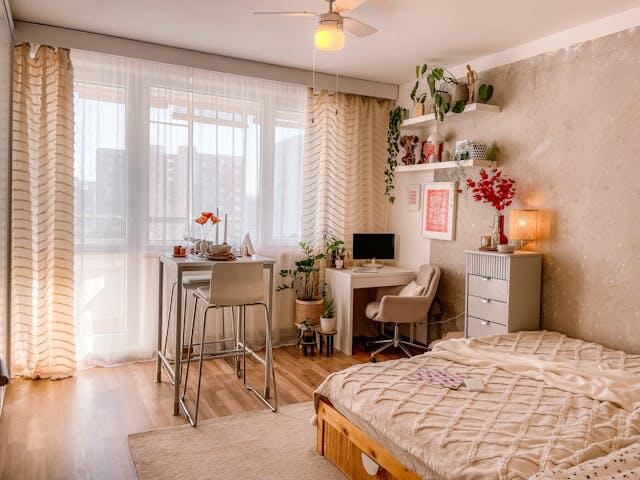
Renting out rooms in a property is currently the most popular option for both landlords and tenants, as it offers flexibility and is more economical than renting the entire property.
If you own a property and are thinking of renting it out, today we are going to explain the details you need to take into account to ensure that everything goes smoothly.
How renting rooms works
Renting rooms consists of renting the property to several tenants by leasing them rooms and allowing them access to common areas such as the kitchen, living room, etc.
This type of rental offers a great deal of flexibility for the owner, as it is not regulated by the Urban Leasehold Law but by the Civil Code in articles 1554 et seq. This means that room rental contracts do not have to comply with certain provisions that do apply to the rental of an entire property. It should be noted that if the purpose of the room rental is for a primary residence, the Urban Lease Law could apply.
For example, room rental contracts are generally not subject to a minimum duration, which is freely agreed upon by the parties in the contract, unless they are intended for a primary residence. There are also no limits in other areas, such as the amount or existence of deposits.
Likewise, renting rooms is a great advantage when the property is located in a high-demand residential area. Until now, rent price limits have not applied to room rental contracts. We say “until now” because the entry into force of the New Housing Law in July 2025 has changed this situation.
What are the landlord's obligations?
Although the law gives landlords and tenants more leeway to negotiate the terms of the room rental agreement, this does not exempt them from certain obligations. Below, we explain the obligations of the landlord:
- Rent the room in a healthy condition, i.e. the room must meet minimum habitability requirements (lighting, ventilation, thermal insulation, etc.).
- Not to enter the tenant's room without permission: the landlord has an obligation to respect the tenant's privacy and therefore cannot enter the rented room without permission. They may access common areas and also regulate tenants' access to them.
- To deposit the security deposit with the relevant body in their Autonomous Community.
- Respect price limits when mandatory: landlords who rent more than one room in a high-demand area or whose room is used as a primary residence must respect the price limits established by the local council.
- Register the contract with the Single Digital Window: with the entry into force of the new housing law, the contract must be registered on a unified digital platform for monitoring by the authorities.
- Declare rental income to the Tax Agency.
What are the tenant's obligations?
The tenant's obligations are as follows:
- Pay the rent on time.
- Pay for utilities if agreed
- Take care of the room and the property in it
- Respect the rules of cohabitation, especially in common areas
Risks of renting rooms
Although renting rooms has obvious advantages, it also carries a number of risks that you should be aware of:
- High tenant turnover: If you rent rooms, you will have to find more tenants for your house, draw up several rental contracts... And every time a tenant leaves the property, you will have to find a new one. Also, as there are more people sharing the same house, the risk of non-payment is higher, although you can mitigate this with the other tenants' payments.
- Care of common areas: Since you are renting out the house by the room, the care of shared spaces such as the kitchen, living room, or bathrooms may be called into question. It is important to establish rules for cohabitation and clarify responsibilities in the event of breakages or damage.
- Conflicts and cohabitation issues: Renting out a property by the room can be complicated, as you will be bringing people who may be very different from one another into the same home. If any conflicts arise, you will have to constantly act as a mediator, with the emotional strain and loss of time that this entails.
How to draw up a room rental contract correctly
To avoid conflicts and legal problems, it is best to make everything clear and set it out in a written contract. Taking into account the freedom given to the parties, it is best to draw up a contract specifying the following points:
- Identification of both parties: both the landlord and the tenant and their identity documents.
- Description of the rented property: room measurements, list of furniture and its condition, description of common areas, etc.
- Rules of cohabitation: establish rules of hygiene and behaviour, define responsibilities for cleaning and caring for common areas.
- Duration of the contract: the duration of the rental period must be specified in the contract. Bear in mind that contracts for rooms, except those intended for primary residence, are not subject to a minimum duration and that it will be determined by the parties involved.
- Rental amount: It is very important to indicate the payment method and the amount to be paid for rent, as well as the form of payment (cash, bank transfer, etc.).
- Deposit: Specify the monthly payments for the deposit and the conditions for its return.
If you want to draw up a guaranteed room rental contract but don't know where to start, contact us.

